
What the Intergenerational Report means for Sydney strata owners


The Australian Government’s 2026 Intergenerational Report looks 40 years into Australia’s future. For anyone who owns an apartment in Sydney, there are some important messages in it, not just about the economy, but about the buildings we live in and how they need to be managed.
The report points to a country that will be older, with smaller households, slower population growth, greater demand for services and significant changes in the way we use energy and technology. For strata owners, that raises a simple question: are we managing our buildings for the next few years, or for the next few decades?
Housing is becoming a generational issue

One of the most striking findings is how much harder it has become for younger Australians to get into the housing market. Home ownership among households aged 25–34 fell by 17 percentage points between 1981 and 2021. The report estimates that if ownership rates had stayed at their 1981 level, around 250,000 more households in that age group would own their homes.
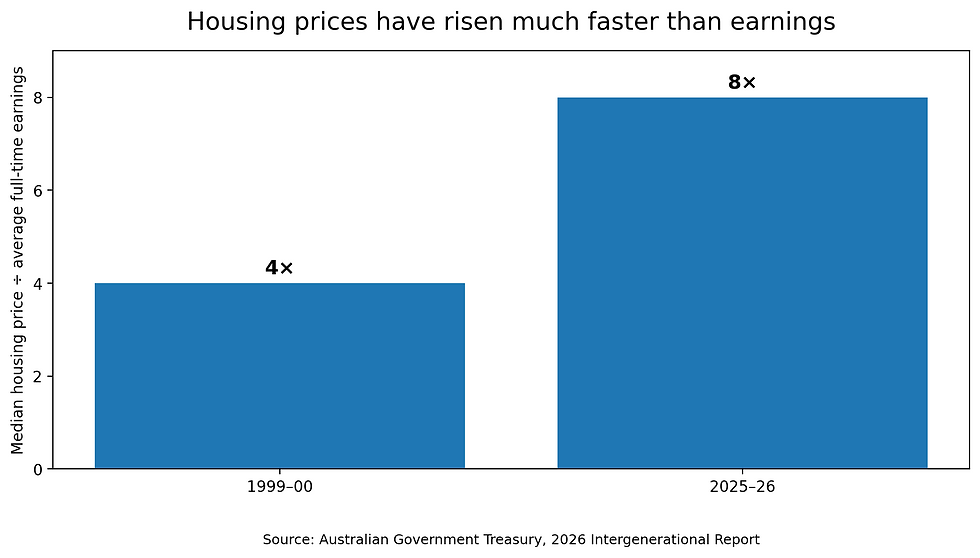
The pressure is particularly relevant to Sydney, where apartments are an important part of the housing market. The IGR says Australian housing prices increased by around 400% between May 1999 and May 2026, while average incomes grew much more slowly. The median house price has gone from roughly four times average full-time earnings in 1999–00 to around eight times in 2025–26.
The result is that apartments are likely to remain an important form of housing for people who cannot, or do not want to, buy a traditional detached house.
That makes the quality of the apartment building itself increasingly important.
An older Sydney means accessibility matters
The IGR projects the number of Australians aged 65 and over to increase by 87.1% between 2025–26 and 2062–63. Even more strikingly, the number of Australians aged 85 and over is projected to increase from about 625,000 today to around 1.9 million by 2065–66.
That has a very practical implication for strata.
A building might look perfectly adequate today, but its accessibility and reliability will matter much more as its residents age.
I see this in something as simple as lift maintenance.
A younger owner might be able to walk up 20 flights of stairs if every lift in a building is out of action. They might not enjoy it, but they can probably manage it. An older resident, someone with mobility issues, or even a parent with a pram may have a very different experience.
And lifts are not like changing a light bulb. Parts can sometimes take weeks or months to source, particularly for older equipment. If a building has allowed maintenance to slide for years, a relatively small problem can become a major disruption.
That is why preventative maintenance matters. It is not simply about keeping the building looking good. It is about keeping the building usable for the people who live there.
NSW Fair Trading now specifically highlights lift outages as an example of a common-property maintenance issue, and NSW strata schemes are required to have a 10-year capital works plan covering major repairs and replacement.

The real cost of cheap strata levies
This is where I think owners sometimes need to change the way they look at strata levies.
Nobody likes paying more in levies. But a low levy is not necessarily a cheap building.
If an owners corporation continually defers maintenance, the bill doesn't disappear. It can simply arrive later, often as a much larger capital works project or special levy.
NSW Government guidance makes the same point: the 10-year capital works plan is intended to forecast major repairs and their costs, while the capital works fund pays for major items such as replacing lifts, roofing and other building infrastructure.
For an owner, the better question isn't always “How low are my strata levies?” It can be “Are my levies sufficient to properly maintain the asset I own?”
What this means for developers
There is also a message here for Sydney developers.
A building should not simply be designed to satisfy today's requirements and then left to future owners to deal with the consequences.
If a building is going to be occupied for 50 or 60 years, developers should be thinking about the whole life of the building: access, lifts, energy efficiency, plant and equipment, maintainability, replacement costs and how easily key components can actually be serviced.
The cheapest component at construction is not necessarily the cheapest component over the life of a building.
This is particularly important as apartment buildings become home to an increasingly diverse and ageing population.
NSW has also strengthened the emphasis on long-term maintenance planning. From April 2026, new and revised 10-year capital works plans use a standard form, and new strata schemes must consider the developer's initial maintenance schedule when preparing their first plan.
Energy is another long-term opportunity
The IGR also points to a major change coming to household energy use.
Treasury expects greater electrification of homes, transport and industry, alongside significant growth in renewable electricity. Under the report's assumptions, average annual household energy costs could fall by around 40% between 2030 and 2050 in real terms as households increasingly electrify.
For Sydney strata buildings, this raises opportunities around solar, batteries, efficient plant, EV charging and better-performing common property.
But again, the important question is not just the installation cost. Owners need to think about maintenance, replacement, access to equipment and who pays for it over the next 10, 20 or 30 years.
Maintenance is not an expense to be avoided, it is part of protecting the value, usability and longevity of the property they own.
The apartment building is the asset
For me, that is probably the biggest takeaway from the Intergenerational Report.
We tend to think of buying property as buying an apartment. But in strata, you are also buying a share of a much larger building.
The roof, façade, basement, fire systems, plumbing, electrical infrastructure, lifts, gardens, plant rooms and common areas are all part of the asset.
As Sydney's population ages, housing becomes harder to afford and more people live in apartments, the quality and management of that shared asset becomes increasingly important.
The best-run buildings won't necessarily be the ones with the lowest levies. They will be the ones where owners understand that maintenance is not an expense to be avoided, it is part of protecting the value, usability and longevity of the property they own.
What should Sydney strata owners be asking?
At the next AGM, I'd be asking:
Are we properly funding our 10-year capital works plan?
When were our lifts last independently assessed, and what is their expected remaining life?
Are we planning for major replacement costs rather than waiting for something to fail?
Is our building becoming more accessible as our residents age?
What major plant and equipment will need replacing over the next 10 to 20 years?
Could solar, batteries, efficient equipment or EV infrastructure reduce future running costs?
If a major piece of equipment failed tomorrow, would the building have the money to deal with it?
The Intergenerational Report is a 40-year document. Most apartment owners won't own their current apartment for 40 years.
But the building will still be here.
That is why the decisions made by today's owners, committees, strata managers and developers can have consequences for generations of Sydney residents to come. Compass Strata is here to guide and help owners make informed decisions concerning your community.


